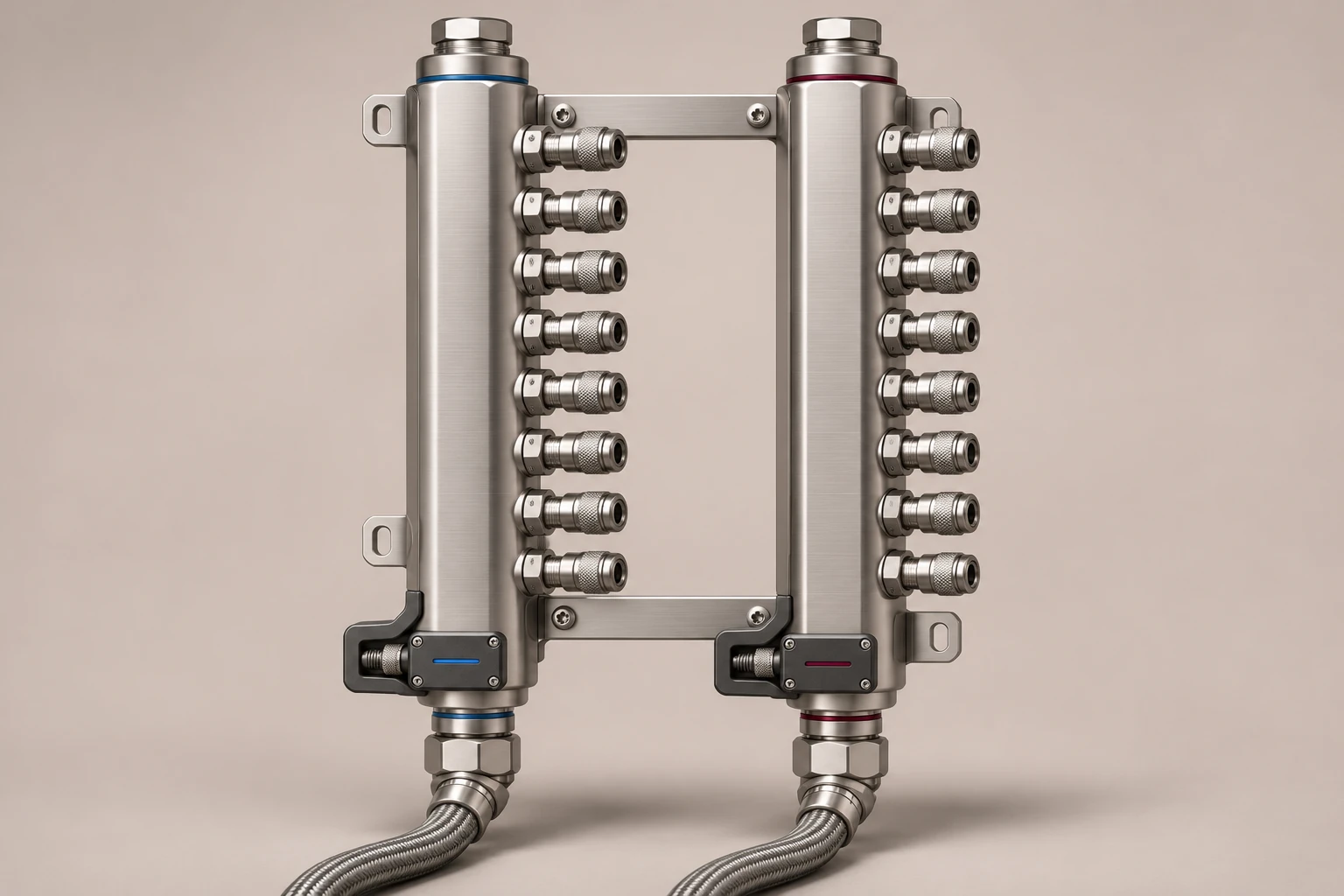
The smart rack manifold
FluidSensing brings supply and return distribution, rack-level sensing and integrated valve control into one assembly. Its control architecture is designed around measured flow, automated valve response and glycol compensation.
The coolant path
The supply header feeds server trays through separate parallel branches. Each branch passes through a tray's cold plates and returns to the return header. The headers connect only through those tray loops. Capped ports carry no coolant. The connected CDU or cooling system removes the heat.
Flow management and automated control
The intended feedback loop compares measured rack flow with an agreed flow target, adjusts the control valve and measures again. Valve position is a command or actuator-feedback value, never a substitute for measured flow. Supply and return temperatures add thermal context; pressure measurements describe the hydraulic conditions at defined points.
Glycol compensation
Use the confirmed fluid type, concentration and concentration basis, together with temperature-dependent fluid properties. Measured flow and paired supply and return temperatures support a fluid-aware thermal estimate. Any correction of the flow measurement depends on the selected sensor and its calibration. Automatic concentration detection is a separate sensing capability.
At the rack
Commission against an agreed flow target and operating envelope. Compare readings after trays or hoses change. A rack total cannot establish flow in every tray, and rack-level control does not imply individual branch actuation or balancing.
Engineering specification
Confirm the coolant, wetted materials, operating limits, sensor locations and calibration, control logic, actuator feedback, communication interface, override and loss-of-signal behaviour for the installation.